
Art forgery challenges collectors and institutions through highly sophisticated replication techniques. Protecting an investment requires objective evaluation methods rather than relying on visual appeal alone.
This technical summary breaks down verification strategies for spotting fakes, including certificates of authenticity (COAs), catalog raisonnés, UV light analysis, paper provenance research, and common red flags for altered artwork.
Verification Using Certificates of Authenticity (COAs)
A Certificate of Authenticity serves as the initial document when assessing an artwork. However, documentation itself can be fabricated to accompany an unauthorized copy. Sophisticated forgery networks frequently generate realistic papers, stamps, and signatures to manipulate provenance records, meaning a certificate is only as credible as its issuer.
Trustworthy documentation originates exclusively from recognized authorities: the living artist, a legally certified estate or foundation, the official gallery of record, or a designated scholarly specialist for that specific creator.
Valid certificates contain verifiable technical details: title, exact medium specifications, precise dimensions, edition numbering (for prints or castings), and clear contact information for the issuing entity. Verification requires cross-referencing these data points directly with the official archive or catalog raisonné of the artist rather than accepting the document on face value.
Catalog Raisonnés
A catalog raisonné is a comprehensive, scholarly listing of all known works by an artist. These volumes are vital for verifying whether a work exists within the artist’s recognized oeuvre.
Tip: If a work is not listed in the catalog raisonné, or is listed as questionable or rejected, proceed with extreme caution. Always consult the most recent edition and verify whether any updates or supplements have been published.
Comment: Not all artists have a catalog raisonné that has been created or published. Additionally, some catalog raisonné do not include every work the artist created. It is common for these catalogs to be compiled after an artist’s passing, and many works may not have been documented by the artist during their lifetime, leading to their omission from the catalog.
UV Light Analysis on Forgeries
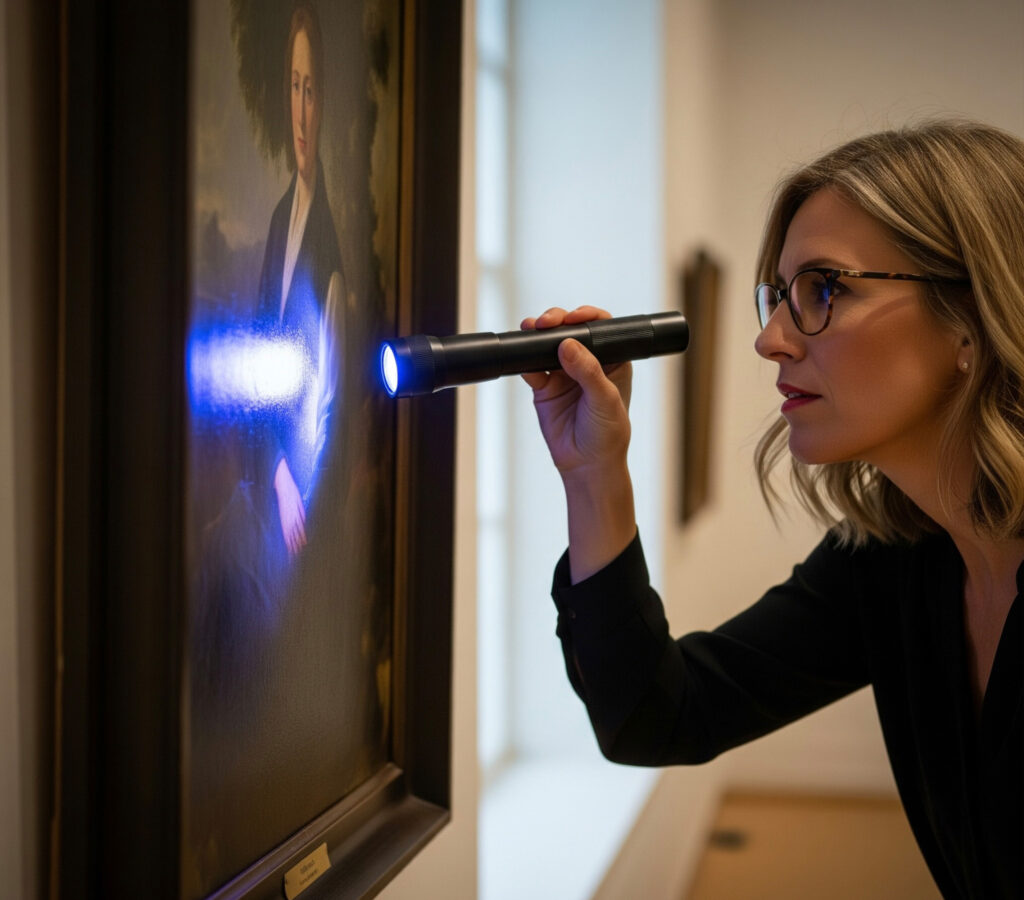
Ultraviolet (UV) light can reveal important clues about a painting’s surface, condition, and age. It can expose repairs, overpainting, varnish layers, and inconsistencies that may not be visible to the naked eye.
Tip: While UV light won’t prove authenticity on its own, it can raise important questions. For example, if a piece claims to be from 1900 but shows modern pigments or restoration inconsistent with its alleged age, that’s a red flag.
Provenance
Provenance is the documented history of an artwork’s ownership. A strong provenance can lend credibility, while gaps or vague histories may raise suspicion.
Tip: Look for documentation like gallery invoices, auction records, exhibition catalogs, published references, or previous appraisals. Be wary of long, undocumented periods or ownership chains that can’t be verified.
Common Red Flags to Detect Forgery
Even without formal tools, your own observation can be a powerful asset. Common red flags include:
- Signatures that don’t match the artist’s known hand.
- Inconsistent materials or techniques for the artist or time period.
- Suspiciously low prices, especially for well-known names.
- Lack of credible documentation, even if a COA is present.
Final Thoughts on Spotting a Fake Item
Authenticating artwork is part science, part scholarship, and part detective work. No single method guarantees authenticity; instead, it’s the convergence of evidence that tells the story. When in doubt, consult professionals: authenticators of that artist, artist estates or foundations, independent certified appraisers, reputable dealers, or auction house specialists.
In the art world, knowledge is your best protection. By arming yourself with the right tools and skepticism, you can confidently build a collection of genuine, valuable works.
Need artwork appraised? Contact Kelly to submit your artwork and get its value appraised.